In early November 2019, a TikTok video was uploaded showing a grey-haired man—thought to be a Baby Boomer (born 1946 to 1964)—declaring that “millennials and Generation Z have the Peter Pan syndrome”. He adds: “They don’t ever want to grow up.” On a split-screen next to him, a Gen Zer (born 1995 to 2015) silently holds up a notepad, saying: “OK Boomer.”
Author: admin
Motherhood, truth, love and guilt: the ingredients of a cracking novel
I’ve always maintained the easiest books to review are the really great ones or the really bad ones. In either case you can become impassioned about the content. Fortunately, in the case of SMH journalist Jacqueline Maley the book was a cracking good read.
The Truth About Her by Jacqueline Maley, published by Fourth Estate
View Article: Motherhood, truth, love and guilt: the ingredients of a cracking novel
Publication: The Age, Sydney Morning Herald - April 2021
Scott Morrison has chosen to ignore the voice of female advisers and constituents at his own cost
The prime minister Scott Morrison finally announced a royal commission into Australian Defence Force and veteran suicides on April 19, 2021, saying that it would “examine all aspects of service in the ADF and the experience of those transitioning from active service.”
Passionate advocate for a Royal Commission, Julie-Ann Finney, said at the time, ‘Today is a long time coming for veterans and their families. Finally, the voices of veterans will be heard. Finally, families can stand up and share their stories.’
Julie-Ann Finney’s son, Royal Australian Navy petty officer David Finney, was discharged from the Navy in 2017, following 20 years of service which included deployments to Iraq, East Timor and Bougainville. In October 2018, feeling desperately unwell, David Finney sought professional help but was told there was a six-month wait to see a DVA psychiatrist. On February 1, 2019, David lost his battle with depression and post-traumatic stress disorder.
Shattered by her son’s death, Julie-Ann Finney turned her grief into anger and petitioned for a royal commission. The basis of her petition was that between 2001–2017, 419 Australian defence personnel had taken their lives. Since then, the rate of suicides has exponentially increased. Among ex-servicemen, the suicide rate is 18 per cent higher than the broader population. Ex-servicewomen are twice as likely to take their own lives as other Australian women.
The prime minister’s initial response to the lobbying was not to establish a Royal Commission but a National Commissioner for Defence and Veteran Suicide Prevention. He thought this somewhat lame concoction of a compromise would make the pesky Julie-Ann Finney go away.
It was around this time that I interviewed her for a book I was writing on the impact of war on veterans’ families. Rather than being mollified, Ms Finney told me she would fight on for what she wanted. She was adamant that her son’s death would not be in vain. With the help of similarly affected families and senator Jacqui Lambi, Ms Finney’s plea for a royal commission was finally heard.
Of interest, the prime minister’s about face has come after a period of turmoil in his government sparked by the allegation of the rape of staffer, Brittany Higgins. Mr Morrison was consequently accused of being tone deaf to the voice of women. His capitulation in terms of a royal commission can be interpreted as his growing awareness of the strength and determination of his female constituents, in particular, those who have lost their sons.
When He Came Home: The impact of war on veterans’ families by Dianne Dempsey will be published by Australian Scholarly Publishing this May
An Embarrassment of Riches: Andre Sardone’s flourishing arts practice
The nesting boxes are all around us, housing kookaburras and robins, sugar gliders and even vulnerable brush-tailed phascogales. Before continuing the tour of Andre Sardone’s studio we get fixed on the brush-tailed phascogales. How can you resist them? The male dead by 12 months from too much, well too much “frenzied mating”.
We look up into a tree and see a tawny frog mouth – the pseudo-owls of the forest. I ask why this abundance of life about them? Sardone says he and his partner Bridget Finch don’t rake and burn around the trees as their neighbours do. The forest creatures love the undergrowth.
The artist’s Mandurang mudbrick house and studio sits unobtrusively in the state forest and as everyone knows it’s been a wonderful time of rain and abundance. “There’s been plenty of snakes this year as well as spiders,” Sardone says cheerfully. A walk around his studio reveals a jacky lizard curled around a sculpture. “Sometimes at night, when we’re lying in bed the bats fly in over our heads.” (I let that comment go by). We move to the settees on the large undercover veranda to drink coffee and talk about his work but before doing so Sardone considerately checks under the settee for the brown snake that was seen last week worrying his dog. I notice for the first time a giant wood moth which must be about 10 centimetres long. The wind nudging its fragile wings.
That the environment is constantly influencing Sardone’s work would be stating the obvious. His latest theme, a profusion of shimmering orbs, are made of recycled materials such as mattress springs, steel rods and stainless-steel discs. The orbs, which hang in his studio, under the eaves of the house and from branches, are expressions of life, of energy, air and movement. Sardone wants everything to move. Walk up to any of his pieces and give it a tap, send it spinning or turning. Nothing rests and when it does, it settles into an agreeable shape.
Sardone’s artistic instinct is to make sculptures which are original. “I like to find a point of difference,” he says. “I don’t like doing multiples. I keep evolving and learning, I don’t know what the end goal will be. So many ideas occur to me and I only have time to fulfill maybe one in every 20. I experiment and learn. I have an idea and realise it.” As an artist, Sardone is suffering from an embarrassment of riches.
He didn’t go to art school and doesn’t refer to his work in traditional art theory terms. He says that he has a “visual aesthetic”. He says, “I have an idea and realise it.”
In essence his art belongs to his ability to change the shape of the material he happens to be using. A roofing plumber by trade, Sardone comes to his art with the skills of his trade. Skills which have exponentially increased according to the demands of the re-cycled material he happens to be using. A turning point for him came some 18 years ago when he was at a building site sheltering in his ute from the rain, reading the Herald-Sun. (There was no mention of a pie or chocolate milk).
“I saw a picture of Albert Tucker’s ‘The Futile City’ and I thought, I can replicate those colours and lines. I worked with colourbond, I was a tradesman and I was bored.” Sardone’s first step into the art world still hangs in his studio. He would never give it away as it’s too significant for him. The colorbond version of “The Futile City” – with its eerily precise match between material and concept earned Sardone much recognition but not necessarily acceptance by the art world. He exhibited in Melbourne in 2003, 2004 and 2005, but he always returned to his work as a roofing plumber; although not so much these days.
In 2006, he and his wife and three children travelled around Australia in a bus. “We came to Bendigo in 2007 and happened upon the land in Mandurang, or rather the land found me.”
In 2013 he re-partnered with photographer Bridget Finch with whom he will be sharing his next exhibition. “She will sit for hours under a tree amongst that undergrowth waiting for a bird to come her way. Bridget started by drawing birds but she has a great eye for photography.” Together the couple have a richly textured life. Of an evening, Sardone enjoys cooking while Finch will play the piano or work in the garden.
Sardone’s work is currently in several galleries but his goal is to put bigger sculptures into bigger spaces. Amongst several projects he is working on are steel sculptures that can be taken apart and then reassembled for installation.
“My children are pretty much launched and these days I’ve got more time, ambition, skills, energy and ideas. I go can in different directions. It’s a wonderful place to be,” he says, smiling. He says he has been highly motivated by the experience of participating in the Emporium Creative Hub Incubator program. “It really gave me confidence; helped to realise that what I’m doing matters and is valued.
This year in the forest that surrounds his home there is more of everything and Andre Sardone is responding with joy to the abundance.
Publication: The Bendigo Magazine Feature - Autumn Addition, 2021
Girls In Our Town
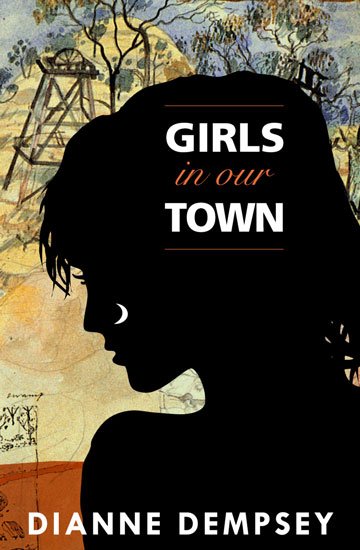
Ghosts haunt the eerie Whipstick forest, just north of Bendigo.
While Sheba is not a girl to scare easily, when she hears a knocking at the door one dark night, it seems the past has come calling. Living in a small community, Sheba knows that whatever is out there she will have to face alone.
Her mother Clover has too many of her own troubles to bother with damaged Sheba and her sister, red-headed chubby Brigid, whose victim status at school is fast reaching dangerous levels.
The extended family, descended from Irish immigrants and steeped in the misery-laden but defiant history of this once gold-rich landscape, can’t possibly help her as she tries desperately to control her longing for her boss, the enigmatic solicitor, Mr Rowley.
Dianne Dempsey’s tender and funny tale is about a sharp-witted girl who yearns to find love and instead finds sex; who struggles to grow and instead finds neglect – it’s about girls in our town.
Her story resonates with secrets that gradually seep up from hidden places and surface with the dazzling clarity of truth.
Like the characters in this beguiling story, the Whipstick Forest is full of toughness and beauty. It is harsh, rich and resilient – hard to get to know and impossible to leave. The forest is not just the setting for this gothic tale; it is one of the principle characters. Dempsey cleverly reveals its dark secrets.
John Wolseley
For decades authors and filmmakers have ‘threatened’ a full-length treatment inspired by Bob Hudson’s beloved composition “Girls in Our Town”…so far there’s only been the song, and a photography exhibition. At long last, Dianne Dempsey’s evocative novel – with its engaging characters, smart humour, refreshing vernacular, mystery / romance elements – is that overdue expansion on the timeless Australiana classic.
Margret RoadKnight
After 20 years of analysing what’s right and what’s wrong about other people’s books, it takes courage to bring out a novel of your own. But Dianne Dempsey delivers her tale of love, family, trauma and a girl from the wrong side of the tracks with an unerring mix of comedy and poignancy.
Jane Sullivan
The Age literary journalist and book reviewer
Girls In Our Town
Bob Hudson ©1975
Girls in our town, they just haven’t a care
 You see them on Saturday floating on air
 Painting their toenails and washing their hair
 Maybe tonight it’ll happen

Girls in our town they leave school at fifteen
 Work at the counter or behind the machine
 And spend all their money on making the scene
 Then plan on going to England

Girls in our town go to parties in pairs
 And sit ‘round the barbecue, give themselves airs
 Then they go to the bathroom with their girlfriend who cares
 Girls in our town are so lonely

The girls in our town are too good for the pill
 But if you keep asking they probably will
 Sometimes they like you or else for a thrill
 And explain it away in the morning

The girls in our town get no help from their men
 No one can let them be sixteen again
 Things might get better but it’s hard to say when
 If they only had someone to talk to

The girls in our town can be saucy and bold
 At seventeen, no one is better to hold
 Then they start havin’ kids, start gettin’ old
 The girls in our town ...
 The girls in our town
The Zeitgeist Throws up Two Timely Works of Art
The novel, The Family Doctor and the movie Promising Young Woman are two powerful examples of art reflecting the mood of the times.
View Article: The Zeitgeist Throws up Two Timely Works of Art
Publication: WR Law Regional Victoria
Date Published: 26/03/2021
The Family Doctor
Debra Oswald is a great example of the amazing versatility of some writers. Not only has Oswald written for television for years (Offspring is her most memorable drama series) but she has written for film, stage, radio and children. She has also written and starred in her own one woman show. Her latest feat is her novel, The Family Doctor, a timely story about the encroachment of domestic violence.
Debra Oswald published by Allen & Unwin
Witness
Once more to the breach dear friends : the fight for women’s rights is far from over
How Robert Richter QC motivated Louise Milligan to argue for law reform.
‘Brittany Higgins and the ‘whole horrible situation’
Brittany Higgins allegation of rape focused an intense media spotlight on the misogynistic culture that pervades our federal parliament.
View Article: ‘Brittany Higgins and the ‘whole horrible situation’
Publication: WR Law Regional Victoria
Date Published: 28/02/2021
When the coach doesn’t quite break the rules
Here’s the scenario: Damien Hardwick is a highly successful coach who has taken Richmond to the 2017, 2019 and 2020 premierships. Part of his shtick is to appeal to his players as a family man with strong values who fights the good fight; and he underlines this message by frequently referring to his wife, Danielle Hardwick, who he says has actively supported his coaching career.
So what happens when the coach suddenly waives the terms of his relationship with his players, as Hardwick did last month? When he says, well actually boys, that bit about values and strength and tenacity – I’ve given myself a get-out clause; and I’m now breaking up with Mrs Hardwick and I’m re-partnering with a much younger woman who works in our sales department at the club.
Hardwick’s situation was so tenuous that the Richmond Football Board had to formally announce that his relationship with the junior colleague was acceptable under the club’s policy.
WR Law’s principal, Rosa Raco, said on her regular Gold FM radio interview that legally, Hardwick hadn’t broken any rules. “Many workplaces actually have a policy where co-worker relationships are not allowed,” she said. “But in Richmond’s case, they didn’t have such a policy.” Ms Raco said the situation was still obviously a worry for the club in that a clear power imbalance existed which is why they met to sign off on it.
Ms Raco explained that the clauses prohibiting relationships in workplaces were there to prevent incidents of sexual harassment and subsequent litigation. She cited the case of David Jones CEO, Mark McInnes, who was successfully sued by a young female employee under the federal Sex Discrimination Act. And while no one is accusing Damien Hardwick of sexual harassment, he has almost certainly taken advantage of his position at the Richmond Football Club – taking what he wants, when he wants.
The much-esteemed AFL journalist Caroline Wilson says Hardwick has almost certainly undermined his credibility with the players. Speaking on the ABC’s Offsiders program she said, “this is a man who created a personal brand out of his partner, Mrs Hardwick…and I just reckon a lot of people at the club feel duped, the public feel duped, the supporters feel duped.”
It would appear that sometimes in the workplace, situations cannot always be seen through the lens of a legal clause but rather we judge it through another lens altogether – that of a moral compass.
Publication: WR Law Newsletter - Febuary 2021